
CASES
When it all went wrong!
How the propaganda works
How this still works in the year 2026.
THE COLD WAR
Built on Lies, Manipulation, and Human Cost

The Cold War was a period dominated by lies, manipulation, and selfish political ambitions. Both the United States and the Soviet Union spread fear and false narratives to justify their actions and maintain global influence. Propaganda portrayed each side as righteous while demonizing the other, keeping ordinary people trapped in a climate of distrust and fear. Behind the facade of ideological conflict, leaders sought power, prestige, and control — often at the expense of truth and human life. Millions suffered, not because of direct battlefield confrontation, but because of proxy wars, political oppression, and paranoia created by leaders more concerned with dominance than with peace. The Cold War ultimately revealed how egocentric leadership and deceit can destroy trust, waste lives, and divide humanity for decades.
The Red Storm
A Short Story about Mao’s Cultural Revolution

In 1966, Mao Zedong felt his power slipping. Other leaders in the Communist Party were questioning his ideas after the failure of the Great Leap Forward. To regain control, Mao launched the Cultural Revolution, claiming it was a movement to protect China’s “true revolutionary spirit.”
Through newspapers, posters, and loudspeakers, propaganda painted Mao as a god-like figure — the “Great Teacher” and “Savior of the People.” Children learned to worship his image and carry the Little Red Book of his quotations. Millions of young people, known as the Red Guards, were encouraged to “destroy the old” — old customs, ideas, and culture. They stormed schools, temples, and even their own teachers’ homes, shouting Mao’s slogans and accusing anyone of being a traitor to the revolution.
At first, Mao gained everything he wanted: total loyalty, fear, and control. But ordinary people suffered enormously. Families were torn apart, intellectuals were humiliated, imprisoned, or killed, and China’s education and economy nearly collapsed. Those who blindly believed the propaganda helped Mao maintain his power — while the truth disappeared behind walls of fear, lies, and red flags.
Echoes of the Jungle
A Short Story about the Vietnam War

In the 1960s, as the Cold War spread across the world, the United States claimed it was fighting to stop the rise of communism in Southeast Asia. Through government propaganda and media control, the war was portrayed as a noble mission — defending freedom and democracy. Speeches promised quick victory, and images of brave soldiers filled American television screens. Few were told about the chaos and horror waiting in the jungles of Vietnam.
As bombs fell over villages and forests burned under chemical weapons like Agent Orange, millions of innocent people suffered. Families fled their homes, farmers lost their land, and children grew up in fear. Many American soldiers returned home broken, realizing they had been fighting a war built on fear and misinformation.
By the war’s end in 1975, the truth was impossible to ignore: more than 3 million people had died — soldiers and civilians on both sides. The conflict had not only divided nations but also destroyed the trust between governments and their people. Propaganda had turned lies into duty, and duty into tragedy.
Moral Reflection: The Vietnam War teaches us that when leaders use fear and propaganda to justify violence, truth becomes the first casualty. Every bomb dropped, every life lost, was a reminder that wars born from lies never bring peace — only suffering and regret.
Fields of Silence
A Story of the Cambodian Genocide

In 1975, after years of war, the communist group known as the Khmer Rouge seized control of Cambodia under their leader Pol Pot. They promised equality, peace, and a new beginning — a society free from corruption and Western influence. But behind these promises hid one of the darkest chapters in modern history.
Pol Pot’s regime spread propaganda claiming that cities, education, and religion were evil. They told citizens that to build a pure communist nation, everyone had to return to the countryside to work as farmers. The media and radio praised the “new agrarian paradise,” while secretly, millions were being forced into brutal labor camps.
The Khmer Rouge abolished money, schools, and family ties. People who wore glasses, spoke another language, or seemed educated were seen as enemies of the revolution. Anyone who questioned the government could disappear overnight. Children were taught to report their parents; neighbors turned on neighbors.
From 1975 to 1979, these lies and paranoid policies killed nearly 2 million people — about one-quarter of Cambodia’s entire population. Many starved to death, others were executed, and countless victims were buried in what became known as the Killing Fields.
The leaders, who claimed to fight for equality, lived in comfort and power. The ordinary people—the farmers, workers, teachers, and children—suffered in silence, victims of propaganda that turned their dreams into nightmares.
Today, Cambodia still carries the scars of those years: empty villages, lost generations, and a deep reminder that when lies become truth, and power goes unquestioned, humanity itself can disappear.
Moral Reflection: The Cambodian Genocide reminds us how dangerous blind belief and propaganda can be. When truth is replaced with fear and obedience, even ordinary people can become tools of cruelty. Power built on lies always ends in destruction — and the silent suffering of millions teaches humanity that memory and truth are the only real defenses against tyranny.
The Shattered Throne
A Story of the Iranian Revolution

In the 1970s, Iran stood between two worlds — torn between Western modernization and deep-rooted Islamic tradition. The country was ruled by Shah Mohammad Reza Pahlavi, a king backed by the United States, who promised progress and wealth. But behind the glitter of new cities and oil riches hid poverty, censorship, and fear. The Shah’s secret police, SAVAK, silenced anyone who spoke against him.
Propaganda across newspapers and television portrayed the Shah as Iran’s savior — a modernizer building a strong, proud nation. But the truth was different. The gap between rich and poor grew wider, religious leaders were exiled or muzzled, and thousands of ordinary Iranians felt humiliated by a regime that served foreign powers more than its people.
Among the exiles was Ayatollah Ruhollah Khomeini, a religious scholar who spoke from abroad about justice, faith, and resistance. His words spread through underground recordings and pamphlets, giving hope to the poor and anger to the oppressed. By 1978, millions marched in the streets, shouting for the Shah’s fall. The army opened fire on crowds. Blood filled the squares, but the protests only grew stronger.
In 1979, the Shah fled Iran. Khomeini returned from exile to millions of cheering supporters. The old monarchy collapsed overnight, replaced by an Islamic Republic built on the promise of purity and freedom. Yet soon, the new rulers used the same weapons of fear and propaganda that had once kept the Shah in power. Newspapers closed, opponents vanished, and new prisons replaced the old ones.
Those who had dreamed of justice traded one cage for another — one dictatorship for a different kind. The revolution had overthrown a tyrant, but it could not free the human spirit from lies and control.
Moral Reflection: The Iranian Revolution shows how easily the voice of the people can be turned into the voice of power. When truth is replaced with ideology, and freedom with obedience, revolutions risk becoming mirrors of the regimes they destroy. Hope can light the fire — but if power takes hold of it, that fire can burn everything it once tried to save.
The Mountains of Fire
A Story of the Soviet Invasion of Afghanistan

In the winter of 1979, the mountains of Afghanistan shook with the sound of helicopters. The Soviet Union, one of the world’s superpowers, had invaded. They claimed they came to “defend socialism” and help Afghanistan build a modern communist state. But the truth was buried under snow and propaganda.
For years, Afghanistan had been torn between modern reformers, tribal leaders, and Islamic movements. When a pro‑Soviet government took control, Moscow feared losing influence in the region. The Soviet leaders told their people they were bringing peace — not war. On Afghan radio, propaganda spoke of friendship and progress, while Soviet soldiers marched into homes and burned villages.
The invasion sparked fierce resistance. Fighters known as the Mujahideen, supported secretly by the United States and other Western nations, rose from the mountains. With old rifles, faith, and determination, they fought one of the most powerful armies on Earth. Afghanistan became a chessboard in the Cold War — a battlefield for the ambitions of distant superpowers.
As the war dragged on, the reality turned to horror. Bombs fell on schools and markets. Entire villages vanished. Families fled to refugee camps across Pakistan and Iran. Over one million Afghans were killed, and millions more were displaced. Soviet propaganda still insisted they were building “a brotherly socialist nation,” but their soldiers bled, froze, and died in a foreign land for a cause no longer clear.
In 1989, after ten bitter years, the Soviets finally withdrew. The empire that had once looked invincible was collapsing under the weight of its lies, just as Afghanistan lay in ruins. The power struggle they left behind would later give rise to the Taliban and decades of new violence.
Moral Reflection: The Soviet‑Afghan War reveals how foreign powers use propaganda to disguise ambition as aid. It shows the terrible cost when nations become tools in another’s game for dominance. Truth was buried under snow, hope under ashes — and once again, ordinary people paid the price for the pride of leaders who never saw the blood on their own hands.
The Crumbling Red Empire
A Story of the Fall of the Soviet Union
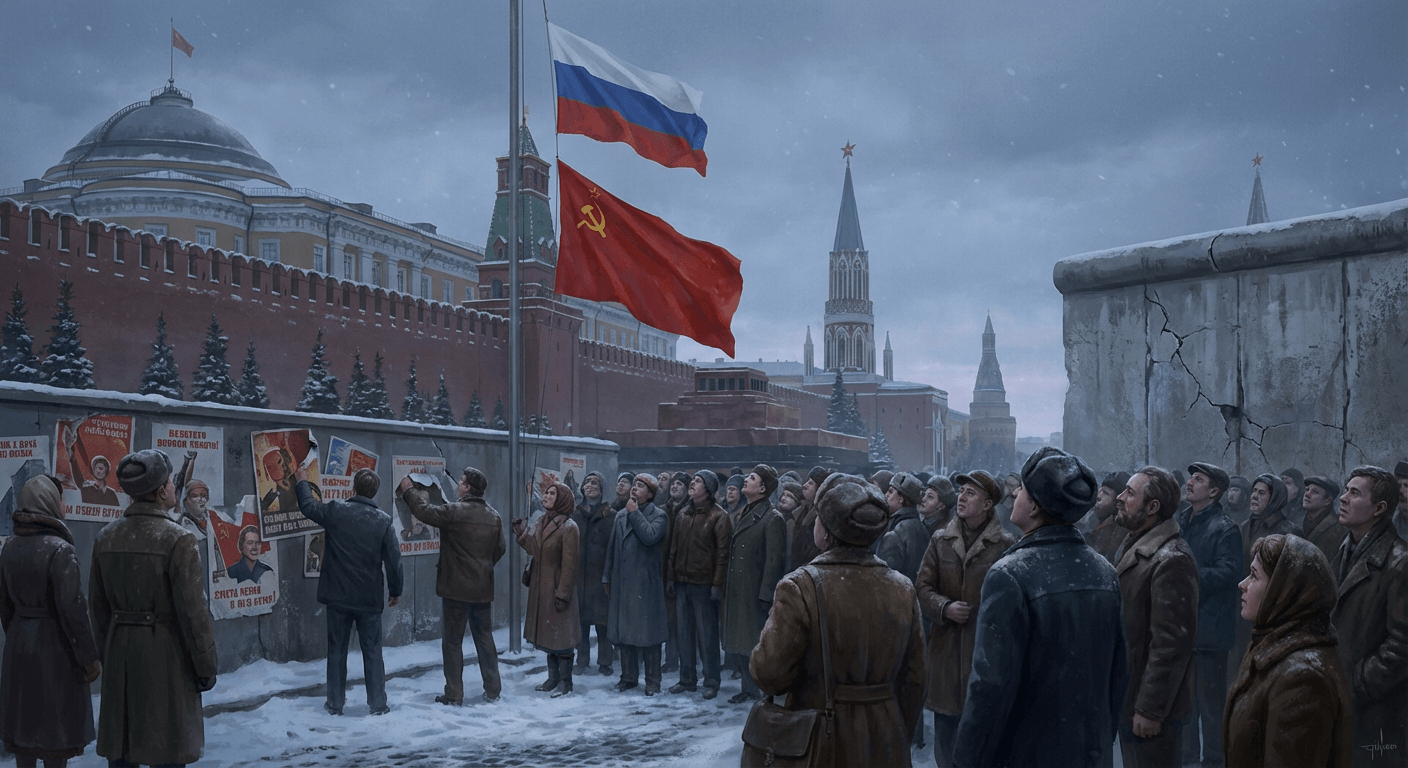
By the late 1980s, the Soviet Union — once feared and respected as a superpower — was slowly collapsing from within. The promises of communism had faded into long food lines, empty shelves, and silent despair. Behind its grand parades and red flags, ordinary citizens lived under censorship, corruption, and exhaustion. Propaganda still called the USSR “the worker’s paradise,” but the people had stopped believing.
Mikhail Gorbachev, the new Soviet leader, sensed the decay spreading through his empire. He introduced Perestroika (restructuring) and Glasnost (openness), reforms meant to modernize socialism and allow limited freedom. For the first time, people could speak openly about the harsh truths — the lies, the prisons, the wasted lives. The silence that had lasted for seventy years began to break.
But with truth came chaos. Once-fearful republics — Lithuania, Estonia, Latvia, Ukraine, Georgia, and many others — demanded independence. In Eastern Europe, communist regimes fell one after another like dominoes. The Berlin Wall came down in 1989, and with it, the illusion of the Soviet dream.
Inside the Kremlin, hardliners prepared coups, hoping to restore control. But even the army refused to fight against its own people. The great Soviet flag, with its hammer and sickle, was lowered for the last time on December 26, 1991. The empire that had ruled one-sixth of the Earth had dissolved into fifteen new nations.
Millions greeted the change with relief — the end of fear, the chance for freedom. But others faced hunger, despair, and uncertainty. The fall of the USSR ended the Cold War, yet left behind scars of poverty, nationalism, and lost identity. The propaganda that once promised peace through control had destroyed the very foundation it stood upon.
Moral Reflection: The fall of the Soviet Union teaches that no empire built on fear and lies can last forever. When truth is silenced, decay begins from within. The red empire fell not from invasion, but from the weight of its own deceit. In its ruins, the world was reminded that freedom — though fragile — is the only power strong enough to outlive tyranny.
Desert of Illusions
A Story of the Gulf War

In August 1990, the world watched in shock as Iraq, under the rule of Saddam Hussein, invaded its small, oil-rich neighbor Kuwait. Saddam claimed Kuwait was stealing oil and belonged to Iraq historically — a story fueled by propaganda to justify his expansionist ambitions. On Iraqi television, he was shown as a heroic Arab defender standing up against Western greed and colonialism. But behind the slogans were hunger for power and control.
Within months, the United States and a coalition of more than thirty nations launched Operation Desert Storm, claiming they were defending international law and protecting global stability. In the West, propaganda painted the invasion as a clean, just war — “surgical strikes” for freedom and peace. News broadcasts showed precision missiles lighting up the skies, but not the families huddled below.
The bombing was relentless. Baghdad’s streets turned to rubble, oil fields burned, and toxic smoke covered the desert like night itself. Tens of thousands of Iraqi soldiers and civilians were killed — some estimates say up to 100,000 lives lost. The war ended quickly, but the suffering did not. Sanctions that followed crippled Iraq’s economy, leaving children hungry and hospitals without medicine.
Saddam remained in power, using new propaganda to cast himself as a survivor and martyr. In the West, politicians celebrated victory while the true victims — ordinary Iraqis and Kuwaiti civilians — disappeared from the headlines. The images of glowing missiles on television had hidden the blood on the sand.
Moral Reflection: The Gulf War revealed how easily truth can be dressed in patriotism and technology. Both dictators and democracies used propaganda — one to justify conquest, the other to justify violence in the name of peace. In war, lies are often louder than compassion, and the desert remembers every echo of human pride.
Ashes and Shadows
A Story of September 11 and the War on Terror

On the morning of September 11, 2001, the world watched in disbelief as hijacked airplanes struck the World Trade Center in New York and the Pentagon in Washington, D.C. Within hours, the towers had collapsed, leaving clouds of dust and nearly 3,000 dead. The tragedy was more than an attack — it was a wound carved into the heart of humanity.
Fear spread faster than the smoke that rose from the ruins. Governments promised justice, unity, and safety, but soon those promises became something else. Under the words “War on Terror,” the United States launched invasions of Afghanistan (2001) and later Iraq (2003). Propaganda told the public that the wars were fights for freedom — against evil that threatened the world. The media showed bombs falling as if they were acts of salvation.
But on the ground, the story was far different. Villages burned, families fled through deserts and mountains, and countless civilians were trapped between foreign armies and extremist fighters. In Iraq, U.S. leaders claimed Saddam Hussein possessed “weapons of mass destruction.” That claim turned out to be false — but by then, it had already justified a decade of chaos. More than hundreds of thousands of civilians were killed across both wars, and millions displaced.
In America, fear was used to pass new surveillance laws and silence dissent. Around the world, distrust deepened between communities, religions, and nations. The fight against terror had turned into a mirror — reflecting the same fear and propaganda that had started it.
Moral Reflection: The War on Terror teaches us that fear can unite a nation — but it can also blind it. When truth becomes a weapon, and humanity becomes collateral damage, justice loses its meaning. September 11 began as a tragedy, but it became a warning: that even in grief, the search for security must never destroy the very freedom it sets out to protect.
The Empty Weapons
A Story of the 2003 Iraq War

In 2003, the world once again watched Iraq appear at the center of global attention. This time, there was no recent invasion of a neighbor, no fresh attack to justify war. Instead, there were words — speeches, reports, and warnings. The United States and the United Kingdom claimed that Saddam Hussein possessed weapons of mass destruction (WMDs): chemical, biological, and maybe even nuclear weapons.
On television, officials spoke with grave certainty. Diagrams, satellite images, and “secret intelligence” were shown as proof. Politicians insisted that if the world did not act, a catastrophe would follow. In parliaments and congresses, fear was carefully shaped into consent. Many who doubted were called naive, unpatriotic, or soft on terrorism. The shadow of September 11 still hung over the world, and propaganda turned that fear into a tool.
In March 2003, the invasion began. Missiles lit up the night sky over Baghdad. Once again, the world saw “precision strikes” and “shock and awe” on their screens — explosions described as necessary, controlled, clean. But on the ground, chaos ruled. Homes collapsed, hospitals overflowed, and families searched the rubble for their children.
As months passed, one truth became impossible to hide: no weapons of mass destruction were found. The main justification for the war had been built on flawed, exaggerated, or manipulated intelligence. Yet by then, it was too late. The Iraqi state had collapsed. Looting, lawlessness, and sectarian violence tore the country apart. Extremist groups thrived in the ruins, feeding on anger, poverty, and humiliation.
Estimates differ, but hundreds of thousands of Iraqis — men, women, and children — lost their lives as a direct or indirect result of the invasion and the chaos that followed. Millions were displaced from their homes. Soldiers from the U.S., the U.K., and other coalition countries returned with physical injuries and invisible scars, questioning what they had truly been fighting for.
Meanwhile, the leaders who had pushed for war spoke of “democracy,” “liberation,” and “regime change,” rarely speaking of the graves that filled the desert. Official language softened the horror: collateral damage instead of dead families, strategic objectives instead of shattered cities.
Moral Reflection:
The 2003 Iraq War stands as a stark reminder of how lies and fear can be turned into policy, and how propaganda can dress aggression as justice. When evidence is twisted to fit a decision already made, truth becomes just another casualty. In Iraq, an entire nation paid the price for decisions taken in distant rooms — decisions justified by weapons that never existed.
This war teaches us that questioning power is not weakness, but responsibility. Because when leaders stop fearing the truth, it is always the powerless who suffer most.
The Black Flags of Fear
A Story of the Rise of ISIS (2011–2019)

Out of the ruins of the Iraq War, in the dust of broken cities and burned homes, a new darkness began to grow. The U.S. army had left Iraq, but the country was divided — torn between corrupt politicians, religious hatred, and hunger for revenge. In the chaos, old soldiers from Saddam’s army and extremist fighters came together, united by rage and despair. They called themselves ISIS — the Islamic State of Iraq and Syria.
At first, most of the world ignored them. But by 2014, black flags waved over entire cities — Mosul, Raqqa, and beyond. ISIS claimed they were building a “pure Islamic State,” a paradise of justice and faith. In reality, they built an empire of fear. Propaganda videos, spread across the internet, showed power and glory — but also terror. Beheadings, executions, and destroyed villages became tools of psychological warfare.
They used modern technology the way older tyrants had used posters and speeches. Social media became their battlefield. Thousands of young people from around the world, craving purpose and belonging, believed their lies and joined their cause. The internet turned ideology into infection.
Meanwhile, civilians suffered the most. In every conquered town, people were forced to obey strict religious laws or die. Women were enslaved; families were massacred. Ancient temples, libraries, and art thousands of years old were reduced to rubble. Millions fled their homes, crossing deserts and seas in search of safety.
The world united to fight ISIS — the U.S., Russia, European nations, the Kurds, and many others. The war against them lasted nearly a decade. City by city, the black banners fell, but the damage was already done. By 2019, ISIS’s “caliphate” was gone, yet the scars it left behind — both physical and emotional — would take generations to heal.
Moral Reflection: The rise of ISIS shows how war and injustice breed new monsters when the truth is buried beneath ruins. Their extremist propaganda fed on the wounds left by earlier lies — proving that violence creates only more violence. When fear replaces understanding, and hate replaces hope, humanity loses its soul. No flag, no faith, and no power is worth the destruction of the innocent.
The Flames of Freedom
A Story of the Arab Spring (2011)

In the winter of 2010, one man’s act of desperation lit a fire that would spread across the Middle East. In Tunisia, a poor street vendor named Mohamed Bouazizi set himself on fire after police humiliated him and confiscated his cart — his only livelihood. His death sparked outrage. Within weeks, thousands marched through the streets demanding justice, dignity, and freedom.
Those cries soared across borders. From Egypt and Libya to Syria, Yemen, and Bahrain, millions of people flooded public squares, chanting that they had endured enough corruption, oppression, and fear. The world watched in awe. It felt like a new age — a tide of hope washing away decades of dictatorship.
Social media became their weapon — phones, cameras, and hashtags spread truth faster than regimes could silence it. The protests seemed unstoppable. In some places, like Tunisia, dictators fell and new beginnings took shape. But in others, power refused to die quietly.
In Egypt, the dictator Hosni Mubarak fell — yet the military retook control soon after. In Libya, propaganda and foreign interference turned protest into civil war, ending with Muammar Gaddafi killed in the streets. In Syria, peaceful demonstrations met bullets, and the revolution drowned in blood. Foreign powers poured money and weapons into the chaos, each claiming to support “freedom” while protecting their own interests.
By the time the smoke cleared, the hope that had filled nations had turned to grief and exhaustion. More than 500,000 people died in Syria, millions fled their homes, and entire cities were destroyed. What began with truth and courage ended with manipulation and misery — as leaders, militias, and global forces twisted the dream of liberty into another battlefield.
Moral Reflection:The Arab Spring began with the belief that truth and unity could conquer fear. But power, as always, learned to disguise itself — sometimes in the voice of the people, sometimes behind the glow of a screen. The lesson is painful: revolutions without justice become prey for those who know how to use hope as a weapon. Yet the spark that started it all — the human desire to be free — still burns quietly beneath the ashes.
Ashes of Aleppo
A Story of the Syrian Civil War (2011–Present)

It began with hope — like so many revolutions before it. In 2011, inspired by the Arab Spring sweeping across the region, ordinary Syrians filled the streets of Daraa and Homs, chanting for freedom and dignity. They carried flowers, not weapons. They demanded the resignation of President Bashar al‑Assad, who had ruled through fear and silence for more than a decade.
The government’s response was brutal. Security forces fired on unarmed crowds, arrested children, and tortured protesters. The videos of these atrocities spread across the internet. What began as peaceful protest quickly turned into war.
As blood filled the streets, new actors entered the fight. Rebel groups formed to resist the regime, while outside powers saw opportunity. The United States, Russia, Iran, Turkey, and extremist organizations like ISIS all turned Syria into a battlefield for their own agendas.
Propaganda flooded the world from all sides: every side claimed to be the “liberators.” Assad’s government called the rebels terrorists; the rebels called Assad a butcher; foreign nations spoke of humanitarian missions while dropping bombs from the sky. Truth vanished behind competing narratives and digital manipulation.
The ancient city of Aleppo, one of the oldest in the world, became a symbol of heartbreak. Entire neighborhoods burned. Hospitals were flattened. Families were buried in rubble, holding one another for the last time. By 2020, more than 500,000 people had died, and over 13 million Syrians had been displaced — half the country’s population.
The war never truly ended; it merely changed shape. Assad remained in power, backed by foreign allies. The world moved on, but Syria remained shattered — caught between ruins and memory, between propaganda and silence.
Moral Reflection: The Syrian Civil War shows what happens when truth becomes a weapon and power becomes the only prize. It began with the courage of ordinary people, but ended in the hands of those who saw human life as another piece on a global chessboard. The lesson is heavy: once lies and violence consume a revolution, freedom dies quietly — not with a scream, but under the weight of dust and forgotten hope.
The Long Road Home
A Story of the Refugee Crisis (2014–Present)

As bombs fell over Syria, Iraq, and Afghanistan, millions of people made the hardest choice anyone can make — to leave everything behind. Mothers carried babies across deserts. Fathers waded through frozen rivers. Children clutched the hands of strangers on overcrowded boats. They were not soldiers, not politicians — just families trying to live.
By 2015, over one million refugees had risked their lives crossing the Mediterranean Sea toward Europe. Many never made it. Rubber boats, packed beyond capacity, sank beneath the waves. Images of small bodies washed ashore broke the world’s heart — for a moment. But compassion quickly gave way to fear.
Across Europe and North America, propaganda shifted. Newspapers and politicians stopped calling them “refugees” and began calling them “migrants.” Lies spread online — that they were invaders, criminals, or threats to culture. Fear became a weapon yet again. Some nations closed their borders entirely. Others built walls.
Yet through that noise, acts of kindness still shone: villagers in Greece sharing bread with the hungry, Germans opening their homes, volunteers rescuing strangers at sea. Even in the darkest moments, humanity quietly resisted the propaganda of fear.
Those who fled left behind not only their homes but also their voices. In refugee camps from Turkey to Lebanon, from Greece to Germany, stories are whispered of the lives they lost — their schools, their jobs, their dreams. Many hope to return one day; others simply hope the world will remember them as people, not as headlines.
Moral Reflection: The refugee crisis is not only a story of war and displacement — it is a mirror reflecting the world’s soul. It shows how easily fear can erase empathy, and how propaganda can turn victims into villains. But it also shows how kindness defies borders and how, even when nations close their gates, hearts can still open. The long road home begins not with walls, but with understanding.
The Invisible Battlefield
A Story of the New Cold War (2014–Present)

When the flag of the Soviet Union fell in 1991, the world believed the Cold War was over. But beneath the surface, new rivalries were only waiting to be reborn. By 2014, the balance of global power began to tilt again — this time not through open battles, but through invisible ones.
It started when Russia invaded Crimea, part of Ukraine, claiming it was protecting Russian-speaking citizens. On television, Russian media celebrated the move as liberation, painting the West as aggressors and enemies of tradition. In Western countries, leaders condemned it as invasion and tyranny. Both sides flooded the internet with their version of the truth, each one louder, faster, and more persuasive than the other.
This was not a war of bullets, but of information. Troll farms, hackers, and bots spread lies disguised as news across social media. Elections were influenced by fake stories. Ordinary people read what they wanted to believe, not what was real. New propaganda no longer came from loudspeakers — it came from screens we held in our hands.
The tension spread across continents. NATO and Russia began military exercises near each other’s borders. China rose in influence, using technology and trade instead of armies. Cyberattacks targeted hospitals, power grids, and government servers. The battlefield had no borders, no uniforms, and no rules.
In 2022, the war turned physical again when Russia launched a full-scale invasion of Ukraine. Once more, propaganda shaped the story — each side claiming justice, each side blaming the other for the suffering. Millions of refugees fled; cities like Mariupol and Bakhmut turned to dust. Online, misinformation blurred every truth until no one knew what to believe.
Behind every post, tweet, or speech, the real victims were the same as always — the innocent, trapped between lies and power.
Moral Reflection: The New Cold War teaches that the world’s most dangerous weapon is no longer the bomb — it is information. When truth becomes uncertain, fear and manipulation take control. The modern battlefield is everywhere: in our phones, in our politics, in our minds. The lesson is timeless — without truth, there is no peace, only noise dressed as reason.
Winter Without End
A Story of the Ukraine War (2022–Present)

In the early morning of February 24, 2022, explosions echoed across Ukraine. Missiles struck cities from Kyiv to Kharkiv, and the sky lit up with fire. Russia called it a “special military operation,” claiming it came to liberate — not invade. But the world saw what it truly was: the biggest war in Europe since World War II.
Propaganda spread faster than the bombs. Russian state media told its people that Ukraine was ruled by Nazis, that it threatened Russian identity, that war was peace. Meanwhile, Ukraine and the West countered with their own flood of images and slogans — of resistance, heroism, and survival. Truth became a battlefield. Each video, tweet, and report carried its own version of reality.
As tanks rolled across the snow-covered fields, civilians fled by the millions. Train stations turned into oceans of luggage, tears, and broken families. Cities like Mariupol and Bakhmut were reduced to ghostly ruins; schools and hospitals became craters in the ground. Soldiers on both sides froze, starved, and died while leaders spoke of victory and national pride.
The world took sides. Western nations sent weapons, sanctions, and support. Russia built alliances elsewhere, using energy and fear as weapons of its own. Online, bots and fake accounts turned sympathy into suspicion, and every tragedy was questioned as manipulation. The war wasn’t fought on one front — it was fought on every screen.
By 2024, tens of thousands of soldiers and civilians were dead, and millions displaced. Yet still, the bombs fell, and the truth remained as fragmented as the shattered cities themselves.
Moral Reflection: The Ukraine War shows that even in the modern age, humanity has not escaped the shadows of history. Empires still hunger, propaganda still poisons, and ordinary people still pay the price. The lesson is painfully clear: when pride and lies rule nations, winter never ends — and peace becomes the one victory no side can yet claim.
The Algorithm of Lies
A Story of the Age of Disinformation (2020s–Present)

The world once feared bombs and armies. Now, it fears something quieter — and far more cunning. In the 2020s, the great battle for truth moved entirely into the digital realm. No smoke, no gunfire — just screens glowing in every hand, whispering half-truths, rumors, and rage.
The Internet, once a promise of connection, became a maze of manipulation. Government agencies, corporations, extremists, and influencers all learned the same trick: control the narrative, and you control reality. Every social media feed became a battlefield of ideas, every comment a bullet, every “like” a small victory in the endless war for attention.
Fake news replaced old-fashioned propaganda. Deepfakes replaced speeches. Artificial intelligence began learning how to mimic faces, voices, and emotions — building illusions more convincing than reality itself. Lies no longer needed soldiers; they could march on their own across the world in seconds.
Elections were poisoned by deceit, public trust eroded, and truth turned into just another opinion. Nations used cyberattacks and influence campaigns against one another, undermining societies from within rather than destroying them from above. The line between war and peace disappeared, replaced by permanent chaos.
And yet, amid the noise, ordinary people tried to hold onto something real — to fact-check, to listen, to think. Rare voices spoke with honesty, though they were often drowned out by anger and misinformation. Truth had become fragile, but not extinct.
Moral Reflection: The Age of Disinformation reveals that the greatest threat to freedom is not censorship, but confusion. When people no longer know what to believe, power no longer needs to silence them — it simply distracts them. In this new world, every truth must fight to survive, and every mind must become its own compass. The future of humanity may depend not on who has the loudest voice, but on who still dares to seek the quiet truth.
Echoes of Deception
The Story of Propaganda from Past to Present

It began nearly a century ago — in crowded halls filled with flags and fury. Adolf Hitler discovered that people could be ruled not just by fear, but by belief. His words, repeated enough times, turned lies into destiny. Propaganda became his weapon, and the world paid in blood.
After the ashes of war, nations swore “never again.” But they carried the same tools forward — only sharper, subtler, and dressed in new forms. During the Cold War, the United States and the Soviet Union fought not only for power, but for hearts and minds. Posters, films, radio broadcasts, and slogans shaped entire generations. Each side claimed truth; each hid deceit.
When the Berlin Wall fell, many thought it had ended — yet propaganda never dies, it only evolves. In the 1990s, television and technology became the new stage. During the Iraq War, satellite news turned conflict into spectacle, shaping emotion on command. Governments learned to weaponize media, and viewers became participants in an illusion of choice.
Then came the internet, and the illusion shattered into endless fragments. Every person became their own broadcaster, every opinion its own headline. In the Arab Spring, hope spread online — until dictators learned to use those same tools to spy, mislead, and control. In Syria, Ukraine, and across the digital world, propaganda abandoned borders. Now, machines, not men, decide what we see, what we believe, and even what we feel.
From Hitler’s microphone to the algorithm’s code, the goal has remained the same: to control perception. The tools have changed — voices became pixels, banners became tweets — but the core has not. In every century, those who desire power learn the same lesson: tell people what they wish to hear, and they will not notice what they’ve lost.
Final Reflection
The story of propaganda is the story of humanity’s struggle with truth. From rallies and revolutions to hashtags and headlines, each age has faced the same temptation — to believe the comforting illusion instead of the uncomfortable fact. But history whispers a warning: lies build empires only for a while; truth always waits beneath the ruins.
If the past century has taught anything, it is this — every citizen must become a seeker of truth, every mind a defender of reason. For when we stop questioning what we see, we hand our freedom to those who speak the loudest. And in that silence, the echo of deception begins again.

Independent & Decentralized | The Real Reminder is an independent digital archive. We operate outside state-controlled narratives. Our mission is to anchor facts where they cannot be erased. No Censorship, No Deletion. Verify, Don’t Trust.